
In 2026, prediction markets underwent changes. That year, major prediction market sites handled more than $50 billion. On a single day, the best prediction market sites trading volume totaled $701.7 million.
Learn more at https://nigeriapredictions.com/.
What Is a Limit Order Book in Prediction Markets?
Order books connect buyers and sellers. They display all buy and sell orders for each contract. When a new order is placed or an existing order is canceled, the order book updates to reflect the change.
Each outcome has a separate book displaying bid and ask prices at every level. The spread, defined as the gap between the best ask and best bid, reflects both liquidity and transaction costs. Depth indicates the number of contracts available to traders at each price level in the order queue. For instance, when 5,000 contracts are offered at the best ask, depth is considered high. When only 50 contracts are available at the best ask, depth is low.
Combining Yes and No contracts typically totals $1 in most markets. The displayed price shows the implied probability for binary contracts and is usually based on the last trade or midpoint, though it may not reflect the next execution price.
How Central Limit Order Books Match Traders
Central limit order books organize all orders by price, then by arrival time if prices match, using established rules to match buyers and sellers.
A Yes share and a No share add up to $1.00. If you buy Yes for $0.60, you are also selling No for $0.40.
Probability percentages refresh every one or two seconds. The blockchain logs each trade within a few seconds. When fewer than five orders are open, an AMM begins operating.
Order Types You Can Use
Traders choose order types on trading venues, affecting order speed, received prices, and paid fees.
- Limit order at set price;
- Market order executes instantly;
- Stop order triggers at threshold;
- Fill-or-kill completes fully;
- Immediate-or-cancel takes partial fills;
- Good-till-cancelled stays active indefinitely;
- Iceberg order shows partial size;
- Hidden order conceals full quantity.
Volume Growth from 2025 to 2026
Trading volume rose by more than 400% from 2024 to 2025 and reached $64 billion. If this pattern holds, 2026 could see totals above $325 billion.
In March 2026, one venue reported $10.57 billion in volume for the month. In April, the volume rose to $24 billion. For the entire first quarter of 2026, total volume exceeded $26 billion.
Since 2024, users have completed more than 43 million transactions each month, up from 240,000. Each month, over 800,000 wallets are in use. Some estimates suggest the total could reach $1.1 trillion by 2030.
Reading Spread and Depth Signals
Entry costs for traders depend on both spread and depth. When the spread is under $0.02, more than 500 trades can occur per hour, but if it exceeds $0.05, trades drop to fewer than 50 in that time.
A popular contract has a size of $50,000 at each level and a 2 cent spread. Deep contracts can absorb $50,000 to $100,000 with minimal slippage, while thin contracts can have a $12,000 order that moves the price by 5 to 10 cents. A niche contract has 50 contracts on each side and a 7 cent spread.
Most contracts display spreads that become tighter over time. When calculating expected value, include data from both the second and third book levels.
How Do Maker and Taker Fees Affect Your Returns?
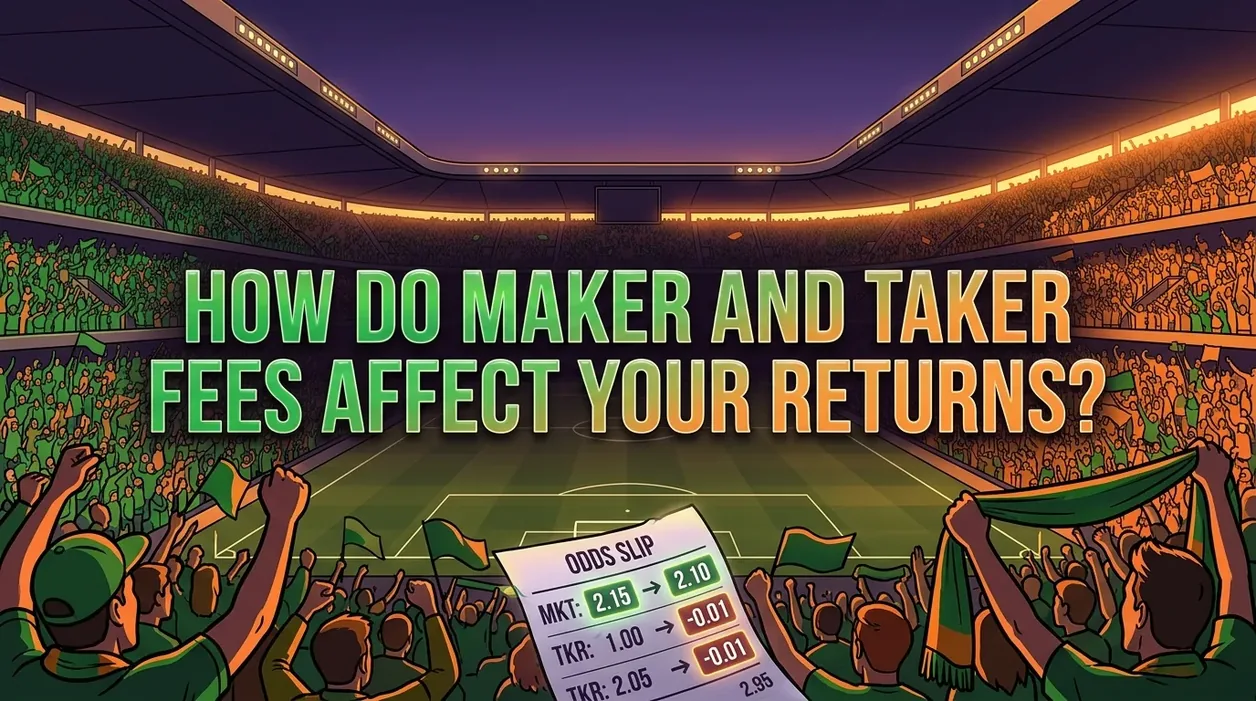
Makers place limit orders and do not pay fees. In some cases, they receive rebates. Taker fees cover the cost of these rebates.
Takers place market orders, and the site calculates their fees by multiplying 0.0625 by the number of contracts, then by one minus the contract price. For 100 contracts at 50 cents each, one site charges $1.75, while another charges $1.56.
Fees in this range are $0.75 to $1.75 for each 100 shares. The exact fee varies by category. Makers earn 15 to 25 percent of the taker fees when their fills generate those charges. One venue has collected a total of $1.15 billion in fee revenue.
Why Did Order Books Replace AMM Models?
Order books have replaced Automated Market Makers. Every outcome token settles at $1.00 or $0.00. The fixed terminal value creates failures that AMMs cannot solve.
One venue used an AMM based on the Logarithmic Market Scoring Rule, but LMSR had a mismatch between algorithmic pricing and binary outcomes. By late 2022, the venue migrated entirely to order books.
Order books provide lower prices and tighter spreads compared to AMMs. On Layer-2, each transaction costs users less than one cent in gas fees.
Market Makers Run Automated Strategies
Market makers set both buy and sell orders on each side of the order book. As market conditions shift, they use algorithms to update their bid and ask prices. Their profit comes from the gap between the prices at which they buy and sell.
Markets often shift by 40 to 50 points when news is released. Wallets with balances over 10,000 fills account for 35.2% of all trades. These larger wallets contribute $774 million in trading volume.
Most traders write market-making code in Python. Others prefer Rust or C++ to reduce latency. The system lets each user make about 300 read requests per minute. Users can also send up to 30 write orders per minute.
Off-Chain Speed Meets On-Chain Security
This architecture divides tasks between two layers. Off-chain, a backend operator collects and matches orders in a way that resembles the operation of a traditional exchange. On-chain, the system records asset ownership and manages settlement.
Users have three trading options: direct match, minting, or burning. With direct match, users send shares directly to another wallet. Minting creates new pairs of Yes and No shares by using collateral.
In early 2026, a network upgrade eliminated gas limit caps. Users no longer pay gas fees. Relayers submit instructions on behalf of users. Each share holds $1.00 of stablecoin as collateral. An oracle protocol oversees resolution.
Platforms That Operate Order Books
As of July 2026, 13 federally regulated venues use an order book model and offer the deepest available liquidity.
- Polymarket on Polygon network;
- Kalshi with CFTC designation;
- ProphetX with American odds;
- OG with multi-outcome contracts;
- MEXC Combo with RFQ matching.
Conclusion
Order books have changed traders’ approach to event contracts. Each trade process involves matching, pricing, and settlement, and the costs for traders depend on factors such as spread, depth, and fee structure.
Volume increased from $64 billion in 2025 to more than $325 billion in 2026. Off-chain matching manages the processing, while on-chain settlement ensures transparency throughout each stage. Shifting from AMMs to order books addressed issues that had previously occurred.
Traders who know how order books work can earn returns. Experts predict that trading infrastructure will expand, since trading volume could reach $1 trillion by 2030.
Related Posts